Compare architectural visualization quotes against the same approved source, creative views, context, revision process, delivery formats and usage rights. Separate design interpretation and model repair from image production. A lower per-image figure is not a complete comparison when one quote excludes work the other includes.
There is no useful single price for an unspecified exterior render. A clean source model and one agreed camera create a different assignment from incomplete drawings, new landscape design and several undecided facades. Start with a scope sheet, then ask providers to price the same package.
Define the unit being purchased
Count independently composed views separately from crops and file encodings. Four approved views delivered as JPG and WebP are four creative views and eight output files, not eight distinct compositions. A second camera position, however, may require its own production and review work.
For animation, specify the sequence and the output versions. The walkthrough storyboard should be part of the quote request so duration does not conceal a completely different route or level of detail.
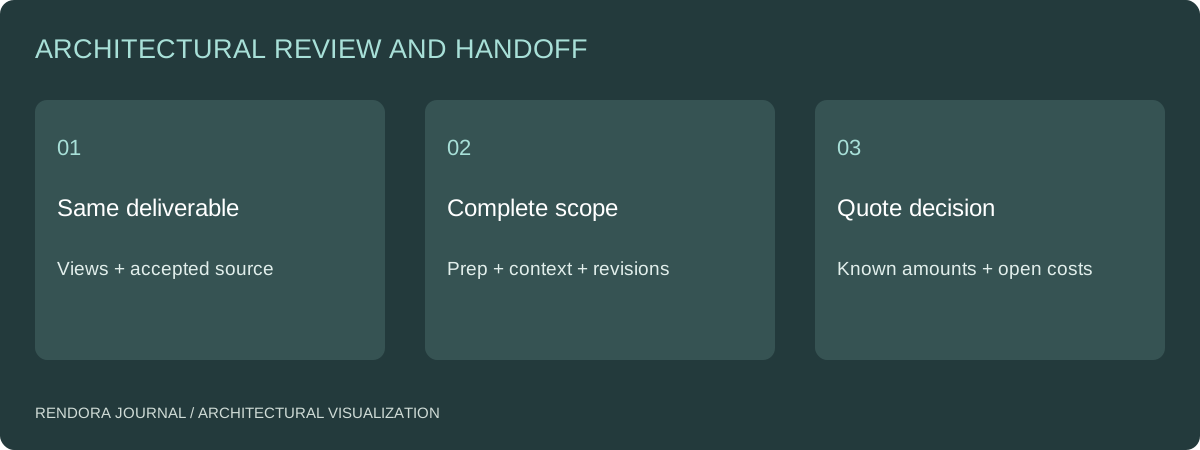
Ask every provider to return the same scope table
| Scope line | Clarification to request | Why it changes the comparison |
|---|---|---|
| Source preparation | Model repair, missing geometry and export work | An apparently ready file may need rebuilding |
| Context | Terrain, neighbors, landscape and entourage | Extent and accuracy affect production work |
| Materials | Supplied specifications or artist interpretation | Missing references create design decisions |
| Views | Camera IDs and approval gate | More compositions are different from more formats |
| Revisions | Included changes and consolidated rounds | Design changes can reopen accepted stages |
| Delivery | Resolution, aspect ratios and source files | A web JPEG and reusable scene are different assets |
| Rights | Image use, scene ownership and third-party assets | Not all resources can be redistributed |
| Schedule | Inputs due, review windows and rush scope | Delayed decisions affect the agreed program |
Use the visualization brief to attach the actual source revision and decisions. A provider should be able to identify assumptions rather than guessing a price from the building’s general description.
Normalize a hypothetical quote without inventing market rates
Consider an authored USD example. Quote A lists $1,800 for source preparation and $2,400 for four views, giving a known subtotal of $4,200. Quote B lists $3,500 for four views but leaves source preparation unquoted. Both amounts exclude tax in this example.
The $700 difference is not a confirmed saving. If B’s source preparation costs more than $700, its total exceeds A’s stated subtotal; if less, it may remain lower. The next action is to obtain that amount and check the remaining scope, not to assume the missing work is free.
Use the same reasoning for context, revisions and rights. A blank cell remains unknown. Keep optional work separate so the team can see the cost of the base package and the effect of each addition. The example describes arithmetic and scope only; it is not a price benchmark.
Define what counts as a change
Distinguish a correction against the agreed brief from a new design instruction. If the delivered image omits an approved window, that is different from the client asking for a new window after camera and geometry approval. Record the source and instruction revision so the distinction can be discussed concretely.
For model-linked production, test updates before agreeing ongoing refresh pricing. Epic’s Direct Link documentation explains an update connection in supported workflows.[1] Even with such a connection, a changed facade may require new material review, composition checks and output acceptance. “Can synchronize” is not the same as “no update work.”
Make the decision package part of acceptance
At delivery, compare output files with the agreed view list. Confirm source revision, resolution, crop, permitted use and outstanding comments. Retain the approval record and any working-file dependencies included in the agreement.
Use the quote-scope comparison sheet to collect like-for-like evidence from providers. Its result and decision fields remain blank for the actual review. The Rendora architecture tool can organize massing, supplied references and scenario records before those requirements are commissioned or reviewed.
Keep a final decision record with the selected option, fixed cameras, conditions, accepted outputs and open tasks. That record is what lets a future update start from a known basis instead of a folder named “latest final.”
Cost questions
Is a per-image quote useful?
Yes, after defining the source preparation, camera, context, finish and review scope. Use it as one line in a complete quote rather than the sole selection criterion.
Should editable source scenes be included?
Include them when the project needs reuse or handoff, and price that requirement explicitly. Confirm dependency availability and third-party permissions. Image usage rights do not automatically establish ownership of every scene asset.
References
[1] Epic Games, Using Datasmith Direct Link. All dollar amounts above are hypothetical inputs used to explain a scope comparison.
About the author
Rendora Journal covers configurable assets, production checks and traceable delivery workflows.