In this guide
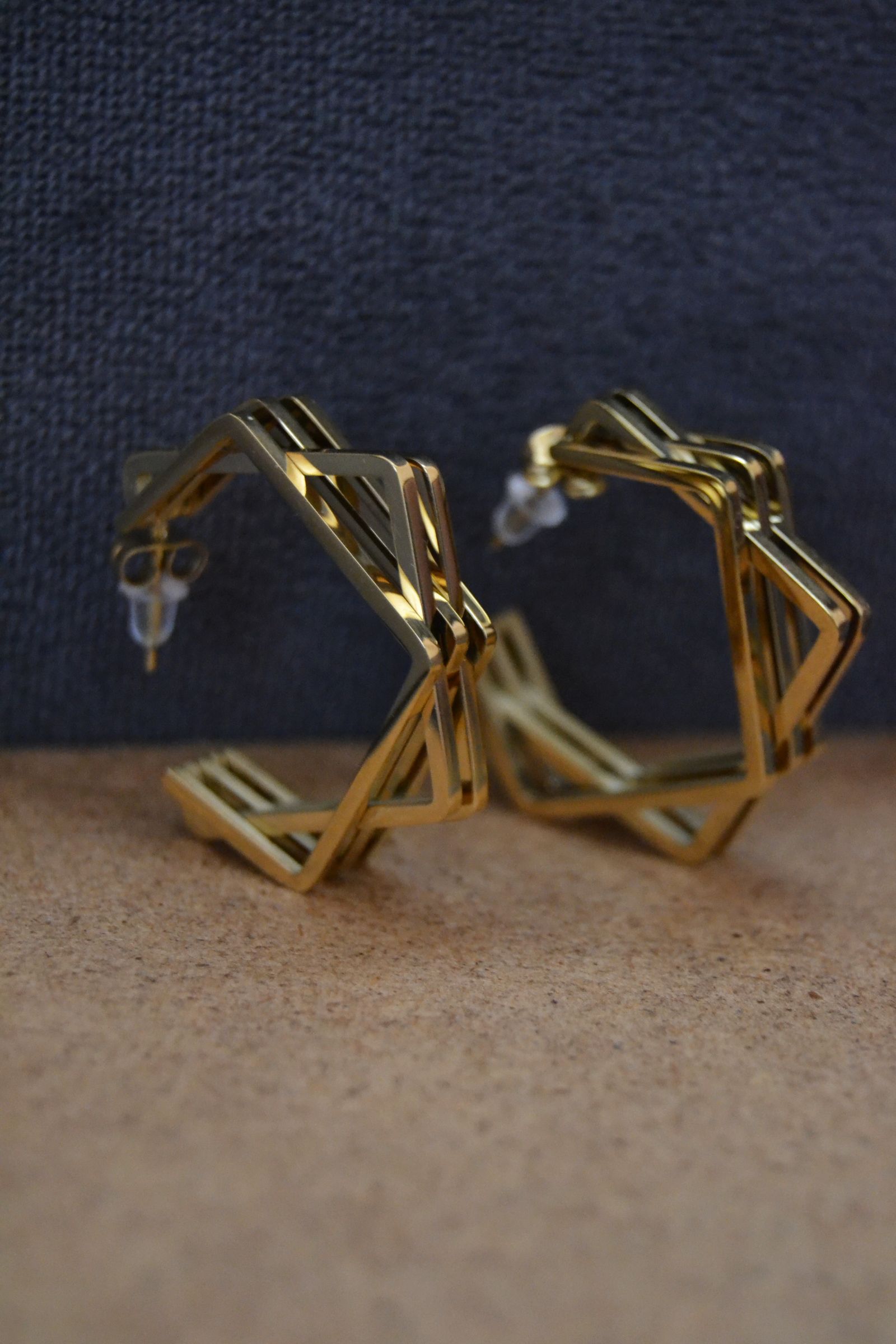
Review mirrored earrings as a pair in a declared wearing orientation. Confirm decorative direction, post or hook location, closures and dimensional relationships on both sides. A mirrored surface can look symmetrical while producing an incorrect or awkward wearing relationship.
State the meaning of left and right at the beginning: wearer-facing or viewer-facing. That small convention prevents contradictory comments when the designer, client and bench team view the pair from different directions.
Define what is mirrored and what is shared
Some designs use identical pieces; others use mirrored ornament with a separately defined post or closure. Record which relationship applies. Do not mirror the entire assembly without inspecting every functional component.
| Element | Intended relationship | Test |
|---|---|---|
| Ornament | Mirrored or identical | Compare pair in wearing orientation |
| Post or hook | Position and direction | Inspect access and seating |
| Closure | Correct mating relationship | Review the actual component source |
| Marking | Readable on intended side | Check after transformation |
GIA’s Quality Assurance Benchmarks provide a production-review framework for jewelry.1 Use an identified bench review for the actual construction rather than treating symmetry as an all-purpose quality verdict.
Compare the same landmarks
Choose landmarks such as the top attachment, ornament tip and the most prominent stone. Compare their relationships in a common view. Preserve individual source identities so a change to the left piece cannot silently leave the right piece on an older revision.
For an intentionally asymmetrical pair, replace a symmetry test with the actual design relationship. Record which dimensions or landmarks should still coordinate. “Not mirrored” is not a defect when the approved concept deliberately differs.
Check transformation side effects
Inspect normals, component orientation and export results after mirroring. Confirm that any lettering remains as intended and that imported components are still represented correctly. Keep source and export review separate: a valid source operation can be mishandled by the receiving workflow.
Do not infer comfort or balance from a single render. Record the physical sample question, such as wearing direction, closure access or movement against nearby features. Keep sample identity linked to both source pieces.
Review the actual pair together
Use a pair view for overall direction and individual views for closures or detailed interfaces. A pair photograph or render should identify which piece is left and which is right where confusion is possible. Ask the reviewer to refer to piece IDs, not “the one on my left.”
The pair-review sheet records this convention, landmark checks and sample findings. Combine it with the jewelry brief and manufacturing handoff.
Release a coordinated pair
Deliver both source revisions, the common pair identifier and the approved orientation views. If one piece is corrected, state whether the other requires a corresponding update. Retain the previous pair release so a repeat order can be traced correctly.
Use the Rendora jewelry entry for supplied-model organization and review evidence. Pair identity and actual wearing behavior should be recorded as explicit checks, not inferred from a generic viewer pose.
Are identical earrings always interchangeable?
Confirm the construction and closure relationship. Visual similarity alone does not establish that every assembly component is interchangeable.
References
- GIA, Quality Assurance Benchmarks, reviewed October 26, 2026.
About this guide
Rendora publishes practical guides for teams working with configurable 3D assets and traceable production handoffs. Updated October 27, 2026.