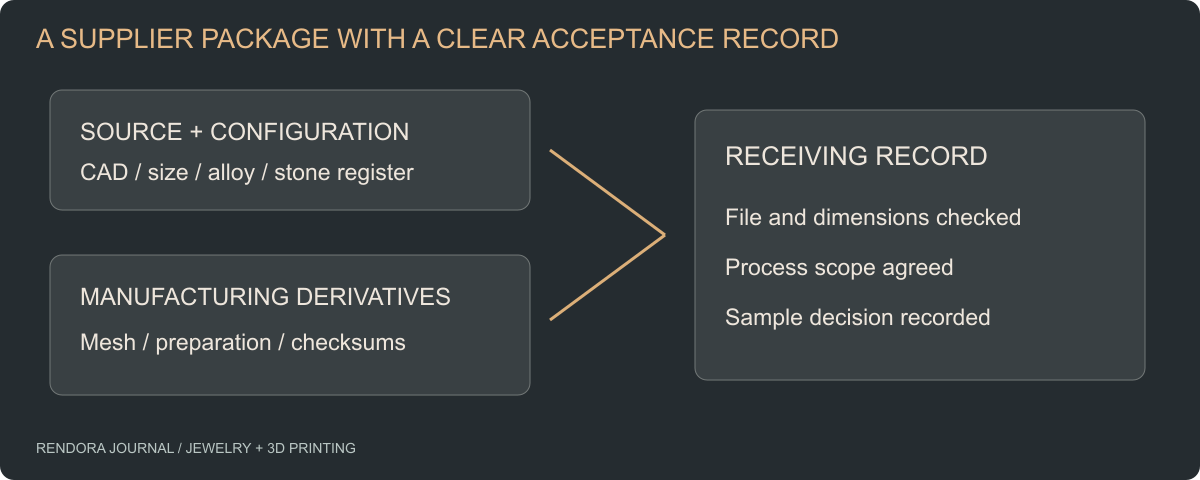
Send a versioned package containing the design identity, manufacturing geometry, dimensions, stone information, process requirements and open issues. Ask the receiving supplier to confirm the exact file, scope, review decision and deliverable before production begins.
Most handoff confusion is not a missing attachment. It is a missing relationship: the drawing describes one revision, the STL another, and the quote says “ring” without identifying either.
A useful package makes the relationships explicit. The designer knows what was reviewed. The print bureau knows what to prepare. The casting house knows what it is accepting. The buyer knows what the quote includes.
Identify the job before collecting the files
Start with a design ID, configuration, revision and intended deliverable. Name the size, alloy and stone set where relevant. State whether the order is for a fitting prototype, printed pattern, raw casting, finished mounting or finished set piece.
Keep these stages separate in the quote. A low price for a printed pattern cannot be compared directly with a finished and set ring. Likewise, an attractive render approval does not answer whether the supplier has accepted the process geometry.
| Package group | What to include | Receiving confirmation |
|---|---|---|
| Identity | Design, configuration, source revision and file hashes | Correct piece and revision received |
| Geometry | Editable source where agreed; manufacturing mesh | Opens at intended dimensions |
| Design requirements | Critical dimensions and stone register | Requirements understood; questions listed |
| Process | Material, preparation responsibilities and applicable guidance | Supplier accepts the proposed route |
| Review | Findings, correction history and sample criteria | Named decision and outstanding items |
| Commercial scope | Quantity, finish, setting, delivery and usage terms | Quote covers the specified deliverable |
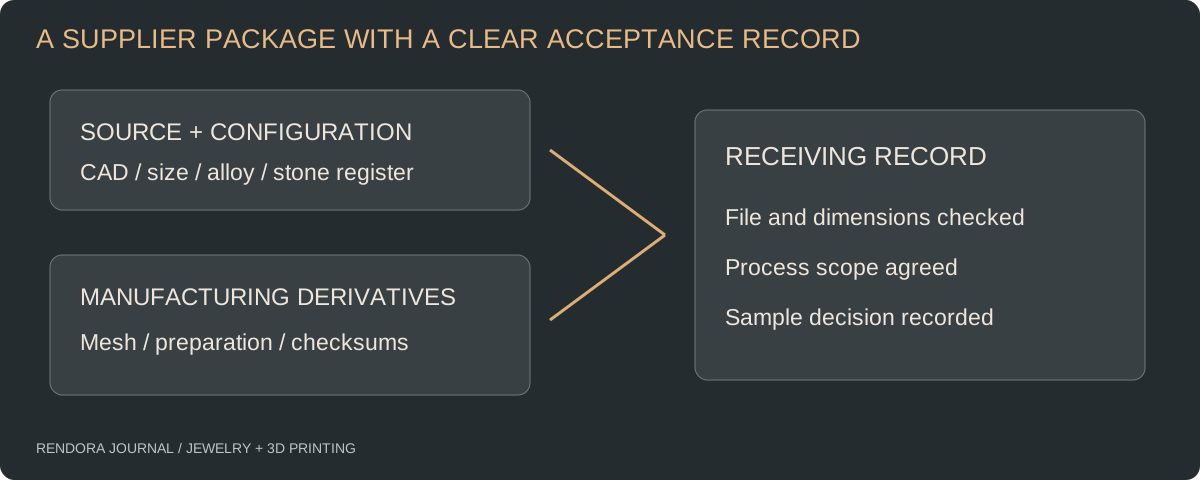
Make the manifest the package’s index
Give each file a role and checksum. Link the exported mesh to its CAD revision, the review images to that mesh and the process record to the supplier’s preparation file. If the package changes, issue a new manifest rather than replacing files silently.
Include a reference dimension for mesh imports. The format guide explains why units and editable geometry should be explicit. Ask the receiver to open and measure the actual delivered file, not just acknowledge that an email arrived.
If the recipient requests a repair, record the issue and return a new source/export pair. Preserve the rejected file and the reason for replacement so the old review cannot be mistaken for acceptance of the new one.
Give each approval a defined meaning
Use separate fields for design appearance, geometric checks, process acceptance and final sample acceptance. Identify the reviewer and the evidence for each. A client can approve the silhouette while the manufacturer still has questions about a section or preparation route.
Avoid a single green “approved” label with no scope. Write what was accepted: “appearance revision D,” “mesh dimensions checked,” or “sample accepted against listed criteria.” Record any conditions and the stage to which they apply.
Rendora’s jewelry tool can produce a candidate STL package, geometry review image and source-evidence records from a supplied manufacturing source. Its reports distinguish submitter-declared values from independently measured results. Retain the manufacturer’s own process decision alongside those files.
Agree a sample review that can settle a dispute
Before ordering a batch, choose the sample and define the inspection. Identify critical dimensions, visible surfaces, stone fit and finished appearance. State who measures, which method is used and which version of the requirements controls acceptance.
A practical review can be small. For a new ring design, it might focus on fitted size, the head and shank transition, specified seat geometry and the visible finish. Add the features that are difficult for this piece rather than copying every possible check onto every job.
For a failed sample, keep the evidence and define the next change. The STL diagnostic guide helps separate file defects from design issues, while the casting workflow helps locate production-stage questions.
Compare quotes against the same scope
Ask whether the price includes CAD changes, mesh repair, support preparation, printed patterns, casting, finishing, setting and inspection. Define the included revision rounds and what triggers a new quote.
Clarify whether metal weight is an estimate, an as-cast measurement or a finished-piece measurement. The weight-estimation guide provides a way to keep the calculation separate from feed metal and commercial charges.
Also settle ownership and use of the source files, permission to manufacture repeat orders, confidentiality and retention of production records. Put those terms in the supplier agreement rather than relying on a filename or download permission to communicate them.
Close the job with a reusable release record
After acceptance, retain the exact files, supplier record, measured sample results and release decision. Identify the scope of the release: one sample, one configuration, a set of reviewed sizes or a repeat batch under specified conditions.
When a stone, size, alloy or source model changes, identify the affected checks. A different stone can reopen seat review. A different material can reopen the production profile. A cosmetic engraving change can affect a local section. Review the dependency rather than assuming that every earlier decision transfers unchanged.
Download the handoff and acceptance register. Fill it with the actual job’s evidence and use it as the index to the release package. The goal is a repeat order that starts from known files and known decisions, not another search through email attachments.
Handoff questions
What is the minimum package for a quote?
Provide the piece identity, geometry or clearly marked concept references, intended dimensions, quantity, material, finish and requested production stage. Ask the supplier what further information is needed to make the quote firm.
Who applies shrinkage or finishing allowances?
Assign that responsibility explicitly. Preserve the finished design target and identify any process-adjusted derivative so the same adjustment is not applied twice.
Does a repeat order need another review?
Check that the geometry, configuration, material and process conditions match the accepted release. Record any change and repeat the affected checks before treating it as the same job.
Further reading
For manufacturer workflow references, see Formlabs’ Castable Wax guide, B9Creations’ casting guide and 3D Systems’ jewelry prototyping overview. Use the guide for the selected material and production route when completing the process record.
About the author
Rendora Journal covers configurable assets, production checks and traceable delivery workflows.