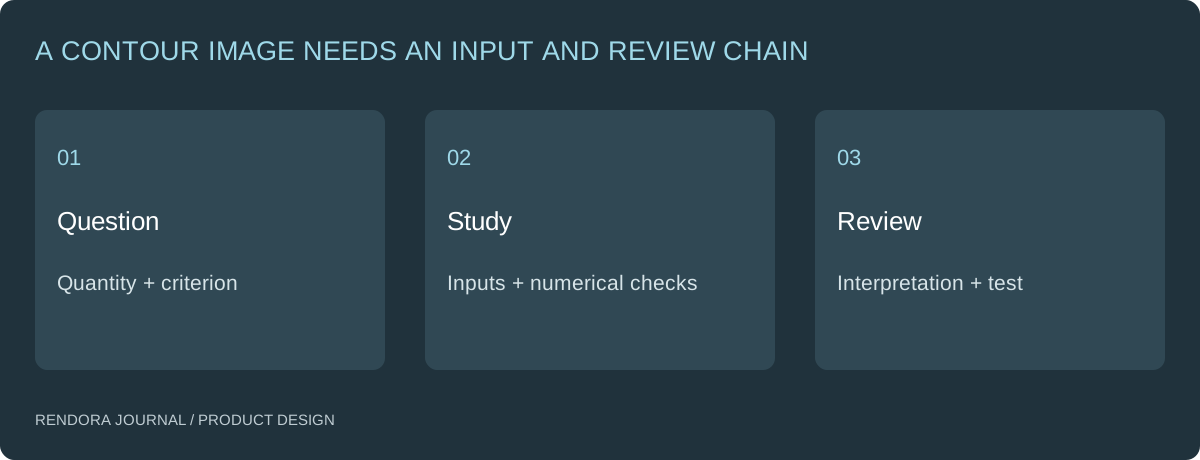
A simulation brief needs a decision, geometry revision, material data, operating conditions, assumptions and acceptance criteria. Agree how the analyst will check the model and results before treating a contour plot as evidence for a design change.
“Run a simulation” is incomplete. It might mean comparing enclosure temperatures, checking deflection under a specified load or examining a proposed flow path. Each requires different inputs and a different interpretation of success.
Start with the decision the team will make after receiving the result. If the action is unclear, the study scope is probably unclear too.
Define the operating case in measurable terms
For an electronics enclosure, identify the components and operating state that generate heat, the environment, the relevant interfaces and the quantity the team needs to compare. For a mechanical part, identify the load case, constraints and output locations.
Use a source for each input. A value copied from another product can be useful for sensitivity exploration if it is explicitly an assumption; it should not silently become measured operating data.
| Input group | Record | Question for the reviewer |
|---|---|---|
| Geometry | Revision, simplifications and selected configuration | What was included or removed? |
| Materials | Property source and applicable conditions | Are the values appropriate to this study? |
| Operating case | Loads, environment and constraints | Does it represent the decision being made? |
| Numerical setup | Solver, mesh and convergence approach | How were numerical effects examined? |
| Acceptance | Quantity, location and agreed criterion | What result changes the decision? |
Make simplifications explicit
An analyst may simplify small features or model components using approximations. Record those choices and their purpose. A simplified model can be effective when it preserves the behavior relevant to the question; an undocumented simplification is harder to review.
Keep the simulation model linked to the design source. If the housing wall or component layout changes, identify whether the study must be updated. A report with the product’s name but no revision is weak evidence for the latest design.
Do not use a presentation mesh solely because it is convenient to upload. Ask the analyst what geometry representation and detail the study requires. The concept-versus-CAD guide explains the handoff distinction.
Ask for a verification plan before the solve
Agree the checks that will establish whether the numerical setup is behaving as intended. These can include input checks, balance checks, comparison with a simpler calculation and mesh-sensitivity work appropriate to the method.
Autodesk’s mesh-convergence guidance describes refining the mesh and examining how results change; it also notes that stress and displacement can respond differently to mesh density. [1] A finer-looking contour image alone does not show that the quantity of interest has stabilized.
Specify the output being checked and the region where it matters. A study that compares overall deflection may need a different review focus from one assessing a local stress concentration. Have the analyst explain the method rather than prescribing one generic acceptance threshold for every study.
Compare alternatives under controlled assumptions
When comparing two housing concepts, keep the operating case and relevant setup consistent. List intentional differences. If geometry, material data and applied loads all change, the result does not isolate a geometry effect.
Ask for a result table alongside images: output quantity, location, units, source revision, operating case and analyst interpretation. Include the unresolved assumptions and the sensitivity results that affect the decision.
For an illustrative thermal comparison, a team might ask whether a revised vent arrangement changes the predicted temperature at a named component under the same operating case. This is a study brief, not a reported simulation. The actual predictions and measured validation results belong in the completed project record.
Connect the study to a physical check
Identify what prototype or test evidence will be used to evaluate the assumptions and conclusions. Agree measurement locations and conditions before the sample is made, especially if access will be difficult after assembly.
A physical test and a numerical model can answer related questions while using different representations. Record the correspondence: which sample matches which design, what operating state was tested and how measurements relate to modeled locations.
Use the prototype acceptance guide to plan that sample. Keep the resulting decision separate from the completion status of a solver task.
Put the request in a reviewable package
Download the simulation brief worksheet. Fill in the source, question, inputs, checks and intended next action before requesting a quote.
Rendora’s product design tool organizes source-linked development work. A planned simulation track is not an executed FEA or CFD study; retain the actual solver report, input model and responsible review with the corresponding product revision.
Is an animated movement a simulation result?
It depends on the operation. An authored presentation movement does not establish loads, contacts or performance. Identify the model and calculations behind any claimed result.
What should the analyst deliver beyond screenshots?
Request the agreed input record, setup assumptions, numerical checks, result quantities, interpretation and source revision, together with reusable files where included in the contract.
What if operating data is unavailable?
Ask for a scoped sensitivity study using clearly stated assumptions, and define which inputs must later be measured before a release decision.
References
[1] Autodesk Fusion: Mesh Convergence — refinement and sensitivity of calculated outputs.
About the author
Rendora Journal covers configurable assets, production checks and traceable delivery workflows.