Accept a prototype against the purpose it was ordered for: appearance, fit, assembly, operation or a defined performance test. Record the source revision, process, measurements, findings and next action so the result can guide the next design.
The prototype arrives and everyone agrees that it “looks good.” A week later, the electronics do not fit. The sample may have been a perfectly useful appearance model; the problem was assuming it had also settled the assembly question.
Define the experiment before ordering the object. A prototype earns its place by resolving a design question, not merely by existing.
Separate the prototype’s purpose from its material
A 3D-printed object can support a grip discussion, an assembly check or a process trial, depending on how it is designed and prepared. The production process and material affect which conclusions are reasonable.
Autodesk describes rapid prototyping as a workflow that can involve design, simulation and fabrication activities. [1] Choose the relevant activity and evidence for your question rather than treating “prototype” as one universal acceptance category.
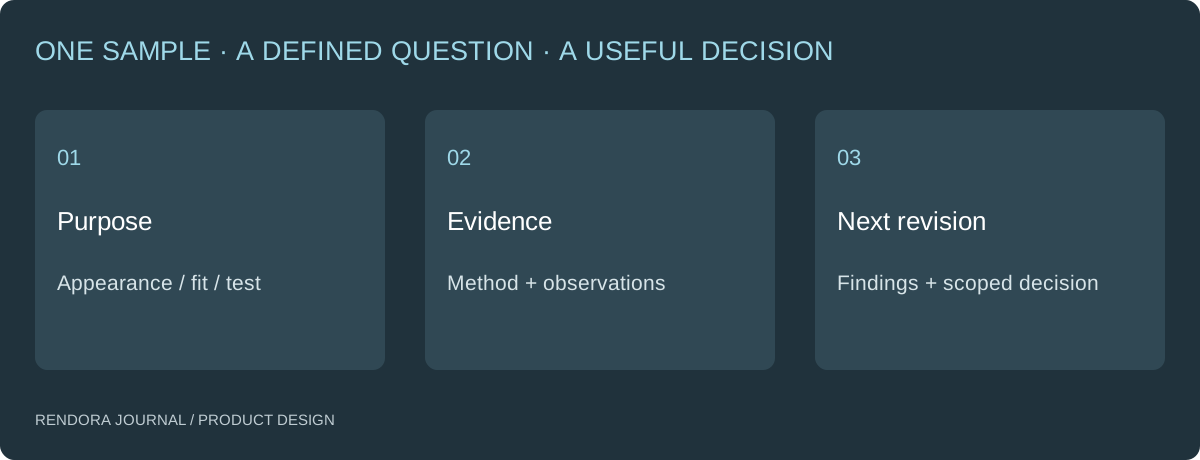
| Prototype purpose | Evidence to collect | Decision it can support |
|---|---|---|
| Appearance | Comparable views and finish references | Select or refine a visual direction |
| Ergonomics | Defined use task and observation record | Refine grip, access or control placement |
| Fit | Measured features and actual mating parts | Resolve specified interfaces |
| Assembly | Sequence, tools and observed access | Revise component arrangement or procedure |
| Performance | Defined test setup and results | Evaluate the agreed operating case |
Freeze the sample identity
Give each physical sample an ID. Link it to the design revision, configuration and supplied file. Record the supplier, material and preparation route, including any changes they made to the file.
If the bureau repairs or scales the mesh, retain the replacement file and reason. Otherwise the team may measure a sample that no longer represents the source it believes was tested.
For assemblies, identify the mating components used in the check. A prototype that fits an old connector revision does not settle the fit of its replacement.
Define checks before looking at the result
Choose the features and tasks that matter. Specify how dimensions will be measured, where a part must seat and what constitutes a finding. If a performance criterion is not yet available, describe the result as exploratory and identify what the team will learn.
Do not fill every possible check into a generic form. A focused grip study needs observations about the hand and controls; a supplier tolerance sample needs defined measurements. Combine purposes only when the sample and methods can support them.
For an illustrative enclosure fit study, identify the board, mounting pattern, connector access and cover closure. Record the dimensions and observed assembly behavior. Leave electrical and thermal performance to the tests designed for those questions.
Record failures so they lead to a change
For each issue, identify location, observation, expected condition and source evidence. Classify whether the cause is a design requirement, model error, file translation, fabrication variation or unresolved assumption.
A port that is visibly misaligned might result from a changed board revision rather than an incorrect housing model. Compare the source records before moving the opening. That diagnosis protects the next sample from repeating the wrong correction.
Retain rejected results. If only successful photographs survive, later reviewers lose the evidence explaining why a feature was changed.
Compare the second sample fairly
Identify the intended design changes and keep the other relevant conditions consistent. If the supplier changes process or material at the same time, record that difference and interpret the comparison accordingly.
Use the same measurement locations and task prompts. For a fit issue, repeat the previously failed operation and inspect adjacent interfaces that the correction could affect. Enlarging an opening can improve access while reducing nearby material.
The simulation brief explains how physical observations can be connected to a numerical study. The supplier drawing guide helps define the requirements for the next fabricated revision.
Decide whether to repeat, revise or release
Close the review with a named decision and scope. “Accepted for appearance direction” is more useful than a general “approved” if dimensional work remains. Assign an owner and action to each unresolved item.
Rendora’s product design tool can keep source-linked configurations and handoff records together. Retain the physical sample results with that source identity; a completed build task is a different event from prototype acceptance.
Download the prototype review worksheet. Its result and decision fields are blank for the actual inspection.
Is one prototype enough?
It depends on the questions, process and observed result. Use the first sample to identify what was established and what needs a further controlled check.
Can a printed prototype prove an injection-molded part will work?
It can inform selected design questions. Review the differences in geometry, material and process with the responsible engineer before transferring a conclusion to production.
What should stay in the release record?
Keep sample identity, source files, requirements, methods, measurements, findings, corrections and the scoped decision. The next reviewer should be able to reconstruct why the design moved forward.
References
[1] Autodesk: Rapid Prototyping with Fusion — connected design and fabrication activities.
About the author
Rendora Journal covers configurable assets, production checks and traceable delivery workflows.