
In this guide
Start a tolerance stack with the functional outcome: the clearance, alignment or travel the assembly needs. Draw the dimensional chain that controls it, assign signs and identify the source of each input. Do not add every dimension on a drawing or assume individually acceptable parts guarantee an acceptable assembly.
This guide uses a simple one-dimensional worst-case example to organize the first review. Complex geometry, deformation, statistical variation and assembly conditions need the corresponding engineering model and evidence.
Define what must remain true
Name the two features whose relationship matters and the operating state. A connector may need insertion clearance while a cover needs closure overlap. The measurement direction and assembly datum should be explicit.
List the dimensions that actually close the chain. Reference the controlled drawing or model revision for each one. If a dimension is only an estimate from a render, mark it unknown rather than using it as a manufacturing input.
| Input | Nominal | Variation | Contribution |
|---|---|---|---|
| Internal opening | 50.0 mm | ±0.2 mm | Available space |
| Insert width | 49.0 mm | ±0.3 mm | Occupied space |
| Nominal gap | 1.0 mm | Derived | Opening minus insert |
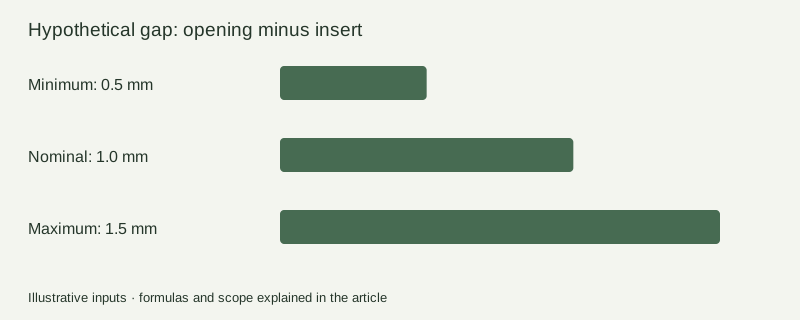
For this hypothetical example, minimum gap is 49.8 − 49.3 = 0.5 mm; maximum gap is 50.2 − 48.7 = 1.5 mm. Whether that range is acceptable depends on the functional requirement. It is not a recommended clearance for an actual product.
Review assumptions before tightening tolerances
Confirm that the features are measured in the same direction and reference system. Check whether coatings, inserts, fasteners, assembly sequence or temperature affect the relationship. A missing contributor can matter more than small arithmetic errors.
If the result fails, consider moving the datum, changing the design relationship or using an adjustment feature before tightening every tolerance. Ask the supplier about process capability and inspection access. A tighter number on a drawing does not establish that the production process can hold it economically.
Keep the method visible
Worst-case interval arithmetic and a statistical stack answer different questions. Do not mix them in one unlabeled total. If using statistical assumptions, identify distributions, dependencies and the evidence supporting them. Correlated dimensions cannot simply be treated as independent because that makes the result look better.
The Onshape release-management description highlights version and revision control in engineering handoffs.1 Keep the stack inputs tied to the released source; even correct arithmetic becomes irrelevant when it uses obsolete dimensions.
Plan a physical check
Choose the features and measurement method needed to compare the first samples with the stack. Record sample identity, instrument or fixture, observed values and assembly state. Keep a fit observation separate from a dimension measurement: a part can fit once without demonstrating the full production range.
Use the stack-input worksheet, which leaves real dimensions and results blank. See prototype acceptance for receiving inspection and supplier drawings for the controlled requirement package.
Rendora’s product tool can organize supplied specifications and configurations. A rendered fit or supplied dimension table is not a solved tolerance analysis.
Stack questions
Should every dimension use the same tolerance?
Choose tolerances by function, process and inspection requirements. Uniform tightness can add cost without resolving the controlling relationship.
Can I use overall bounding-box dimensions?
Only when they represent the functional chain. Local interfaces and datum relationships often control the outcome instead.
References
- Onshape, Release management, checked October 26, 2026.
About this guide
Rendora publishes practical guides for teams working with configurable 3D assets and traceable production handoffs. Updated October 26, 2026.