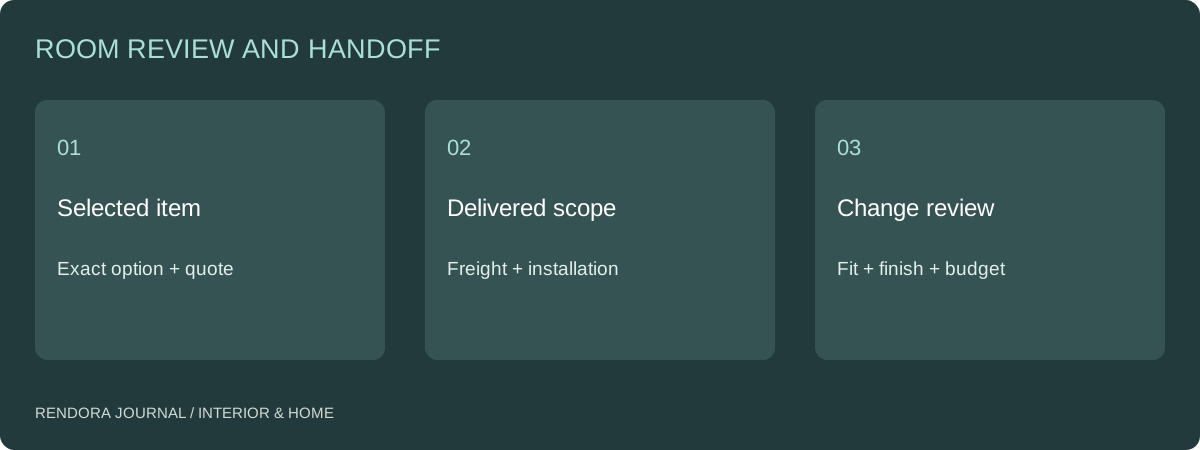
An FF&E budget should connect every selected item to its quantity, exact option, quoted price, delivery scope and approval status. Compare substitutions at the delivered and installed scope, not just the product subtotal. An empty freight or installation field is an unresolved cost, not a zero.
Furniture, fixtures and equipment decisions become difficult when the presentation and purchasing sheet drift apart. The client approves a pale upholstery in an image, the budget contains the base fabric price, and the supplier quote describes another size. The budget needs to identify that mismatch before the order is placed.
Give each budget line a decision identity
Start with the room ID and item ID already used in the plan. Add manufacturer, SKU, size, finish, quantity, quote date, quote reference and the person responsible for confirming it. Keep a link to the approved image or sample where appearance matters.
Do not combine “living room furniture” into one line if its components can be approved, substituted or delayed independently. Conversely, do not split a supplier’s inseparable package into invented unit prices. Match the line structure to the decisions and the quote.

Separate the layers of cost
Use a clearly labeled currency for the project; the example below uses USD. Ask whether a supplier quote includes delivery, assembly, installation and tax, and who carries responsibility for each service. A delivery to a loading dock and placement in an upstairs room are different scopes.
| Cost layer | Question before comparison | Evidence |
|---|---|---|
| Product | Is this the approved size and finish? | Itemized quote and option codes |
| Freight | What is the delivery destination and service? | Carrier or supplier delivery terms |
| Access | Are stairs, elevator booking or unusual handling included? | Site and delivery assessment |
| Assembly | Who supplies labor and packaging removal? | Written service scope |
| Installation | Are mounting, trades and accessories included? | Installer scope |
| Tax | Which quoted amount is subject to tax? | Applicable project pricing confirmation |
| Design/change work | Is reselection or redraw included? | Service agreement |
Keep allowances visible. If freight is not quoted, enter an allowance only when the project team intentionally adopts it, label its basis and assign a confirmation date. Do not present the allowance as a supplier commitment.
A lower item price can leave the comparison unfinished
Here is an authored arithmetic example, not a market benchmark. Option A has a product subtotal of $2,400 and a quoted delivery-and-assembly charge of $250. Its known subtotal before tax is $2,650. Option B has a product subtotal of $2,100, quoted freight of $180 and unquoted assembly. Its known subtotal is $2,280 plus the unresolved assembly cost.
The visible difference is $370 before that missing scope and before any tax differences. You cannot call $370 an actual saving until both options cover the same service and the remaining amount is confirmed. The right next action is to price the missing scope, not to color Option B green.
For quantities, separate unit price and extended price: quantity multiplied by quoted unit price. Keep percentage allowances on their stated base rather than adding them repeatedly to subtotals. If the budget changes currency, retain the source amount and conversion date instead of silently replacing it.
Review substitutions as design changes
A substitution is not equivalent merely because the price fits. Compare dimensions, operation, finish, availability, care requirements and delivery conditions. A wider sofa may require a new room-fit review; a new upholstery may reopen the material-board approval.
Keep the original and proposed item side by side. Identify the reason: stock, lead time, cost, damage replacement or client preference. List the affected plan, image, sample and budget revision. A client can then approve a specific tradeoff rather than a vague “similar alternative.”
Project schedules also matter. Houzz Pro’s scheduling guidance describes coordinating project activities and participants.[1] Link a purchasing decision to the actual required date and responsible person; do not use a general availability label as a delivery promise.
Close the loop between proposal and purchase
Use the FF&E budget review sheet to record the evidence behind each line. It is a blank review template, not a live quote calculator. Keep quoted amounts in the purchasing record and link them from the review so later changes remain traceable.
The Rendora interior proposal can include supplied item prices and a bill of materials. Those entered values organize the selected configuration; confirm current purchasing terms with the supplier before ordering. Carry the selected item IDs and the accepted scope into the client handoff package.
Budget questions
Should a contingency replace missing quotes?
No. A contingency is a planned reserve for its defined purpose. Missing freight, tax or installation information remains an open line even if the project also holds a reserve. Separating them shows what still needs a quote.
When should a substitution trigger new images?
When the visible form, finish or arrangement changes enough to affect the decision. Preserve the approved version and issue the affected view with the new item ID. A price-only correction usually belongs in the budget record rather than a complete visualization rebuild.
References
[1] Houzz Pro Help, Creating your project schedule. The cost example is authored arithmetic with stated hypothetical amounts.
About the author
Rendora Journal covers configurable assets, production checks and traceable delivery workflows.