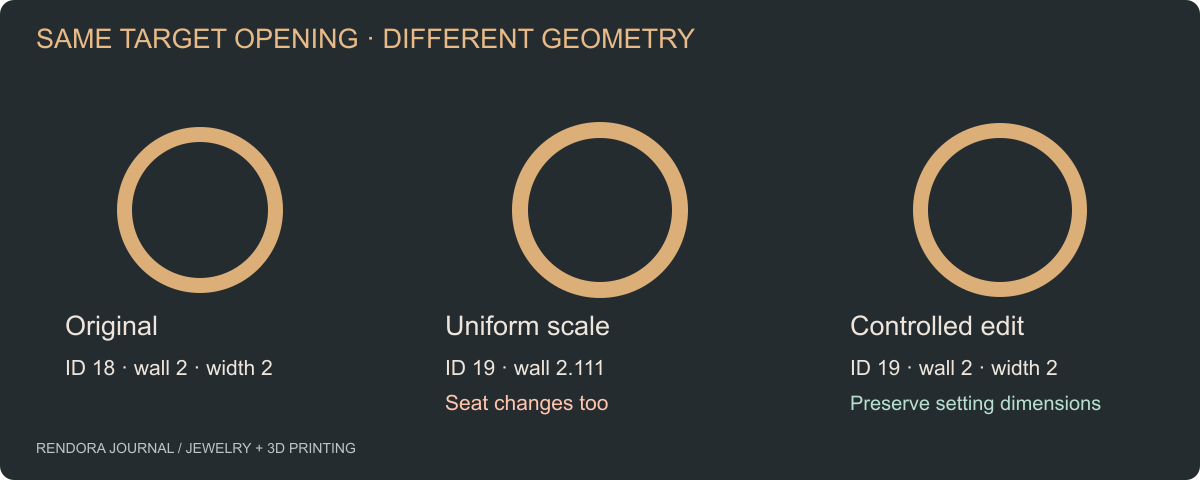
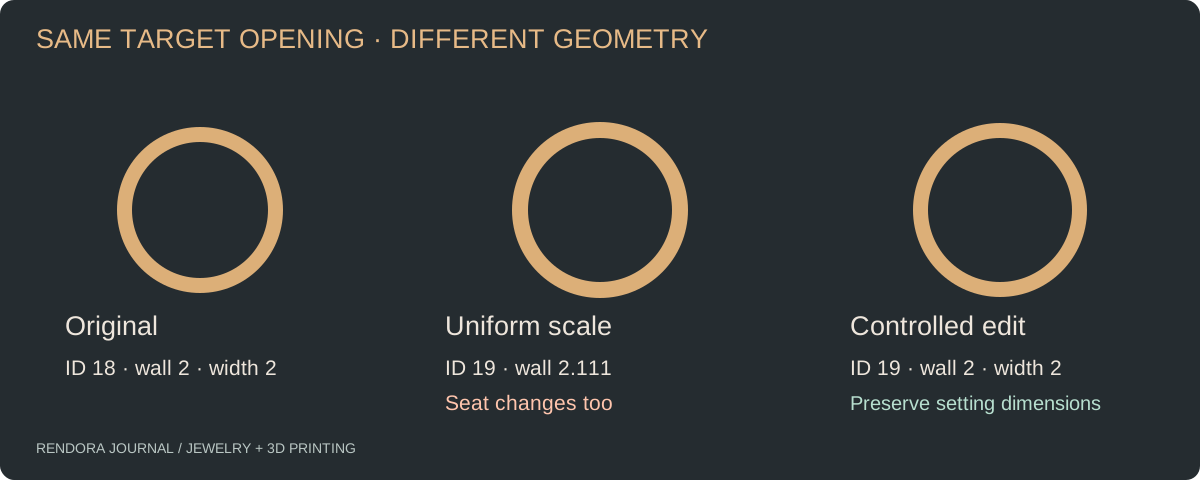
Change a ring’s fitted geometry deliberately: confirm the target measurement, edit the shank while preserving the stone and setting requirements, then recheck sections and fit. Uniformly scaling the whole ring also changes the head, seats, prongs and band width.
The shortcut is tempting. A ring needs to be larger, so select everything and enter a scale factor. The internal diameter increases—but so does every detail that was supposed to stay matched to an actual stone.
A useful sizing workflow treats the ring as connected features with different constraints. The finger opening can change while stone dimensions remain fixed. Some settings need broader redesign; the correct operation depends on the construction.
Specify fit before editing geometry
Record the size system, measurement method, band width and interior profile. If you are matching an existing ring, record where it was measured and whether it is round. GIA’s sizing guidance distinguishes narrow and wide bands, tapered rings and convex interiors. [1]
Keep the wearer’s fit target separate from manufacturing compensation. The target describes the finished piece. A process allowance describes an intermediate model and should come from the manufacturer’s measured process. Combining them into one unexplained “extra size” makes later correction difficult.
What uniform scaling changes: a worked example
Consider a simple band with an 18 mm internal diameter, 22 mm external diameter and 2 mm axial width. Its radial wall is (22 − 18) / 2 = 2 mm. To reach a 19 mm internal diameter by uniform scaling, the scale factor is 19 / 18, or about 1.0556.
| Dimension | Original | Whole-model scale | Dimension-controlled change |
|---|---|---|---|
| Internal diameter | 18 mm | 19 mm | 19 mm |
| External diameter | 22 mm | 23.222 mm | 23 mm |
| Radial wall | 2 mm | 2.111 mm | 2 mm |
| Axial band width | 2 mm | 2.111 mm | 2 mm |
| Hypothetical 6 mm seat | 6 mm | 6.333 mm | 6 mm |
The last row is an arithmetic illustration of scaling a seat; the downloadable band has no stone seat. The comparison shows why “the hole is now correct” is not enough to accept the entire design.
Download the sizing calculations and review worksheet. The calculations are design examples, not a conversion chart between named ring sizes.
Divide the design into changeable and protected features
Before editing, identify the shank, shoulders, head and stone seats. State which dimensions are protected. A measured stone envelope, seat positions and required setting stock deserve explicit constraints.
For a plain circular band, a controlled edit may change inner and outer radii while retaining width and wall. For a solitaire, the designer may need to preserve the head and rebuild the transition into the larger shank. For a continuous patterned band, repeating elements and spacing may need redistribution rather than stretching.
Use a section through the changed area to verify the result. Top views can hide thin shoulder transitions. Check the internal opening, narrowest wall, band width and joins to the protected features. Compare the same views before and after the edit so the reviewer can locate intentional changes.
Separate design allowance from process allowance
If a casting house requests compensation, ask which process, alloy, geometry and measurement stage the recommendation covers. Record whether the bureau will apply the adjustment or expects it already in the supplied file. Otherwise both parties may compensate the same geometry.
Do not reuse an allowance from another supplier without confirming it. An as-cast dimension and a finished polished dimension answer different questions. The casting handoff guide provides fields for recording that responsibility.
Keep the fitted design master and process-adjusted derivative distinct. When the supplier changes, you should be able to prepare a new derivative without reverse-engineering an unexplained scale from the only remaining file.
Recheck affected features, not just the size label
For each size revision, compare the head position, stone spacing, shoulder transitions, engraving and mating parts. A larger opening can change the way a decorative pattern closes around the ring. A local shank edit can also change its connection to the head.
If a fitting prototype is part of the project, define its purpose and how it will be measured. Record the prototype material, measured dimensions and wearer feedback alongside the source revision. A physical fitting result becomes much more useful when the later CAD change is traceable to it.
When the geometry is ready, export the mesh and run STL preflight again. The accepted earlier size does not automatically accept a new export. The same applies to thin-feature review.
Manage size options without losing the master
Store the intended size as a configuration of a design whose dimensions are controlled in CAD. Keep derived print files linked to that source and configuration. Do not use a viewer’s overall scale control as the manufacturing sizing system.
Rendora’s jewelry tool can organize source references and configuration-linked handoffs. Make the size-specific CAD change in the design source, then attach the corresponding manufacturing mesh and review record.
Ring-sizing questions
Is scaling ever appropriate?
It is appropriate for a verified unit conversion or an explicitly agreed geometric transformation. For a fit change, inspect which dimensions must stay fixed before choosing the modeling operation.
Can the same target diameter fit every band comfortably?
Band width and interior shape affect how fit is assessed. Use the appropriate measurement method and record the actual design profile rather than relying solely on a nominal label.
Should every size share one manufacturing approval?
Record which sizes the review covers. A change that affects thickness, setting geometry or production preparation needs the corresponding checks repeated and linked to the new revision.
References
[1] GIA: Accurate Determination of Finger and Ring Sizes — measurement methods for different band and interior forms.
About the author
Rendora Journal covers configurable assets, production checks and traceable delivery workflows.